
(Unpublished lecture delivered in the series, Imagining Planetarity: World Picturing, Placemaking, Connectivity. Carnegie-Mellon University, November, 2011)
Alien Earth: Science Fiction, Posthumanism, and The Planet
Let me confess that I don’t think I ever heard the word planetarity before I was invited to speak to you; you would think that as a specialist in science fiction I would have. After all, scholars and writers of science fiction deal with a great range of imagined planets; and since what we term “world building” is one the main requirements of science fiction, each imaginary planet is expected to have its own character, including the Earth. If we were to use the term, and I’m pretty sure we will be soon, it would probably refer to the figural play with which sf artists construct their planetary settings – such as the heavy gravity of the planet Mesklin in Hal Clement’s Mission of Gravity, the centuries-long seasons of Brian Aldiss’ Helliconia, the intense cold of the planet Gethen in Ursula K. Le Guin’s Left Hand of Darkness, or the plasmic ocean of Stanislaw Lem’s sentient planet Solaris. But in our consensual here and now, “planetarity,” as some of you surely know better than I, has come to have significant role in the work of two of the leading post-colonial theorists, Paul Gilroy and Gayatri Chakravorti Spivak, and has become a contested concept in critical globalization studies. Gilroy, in his book After Empire published in 2004, proposed a model for reconceiving human relations in our era in terms of a new cosmopolitan point of view whose emblem is the famous image of the earth taken from outer space on the Apollo 17 spacecraft in 1972.
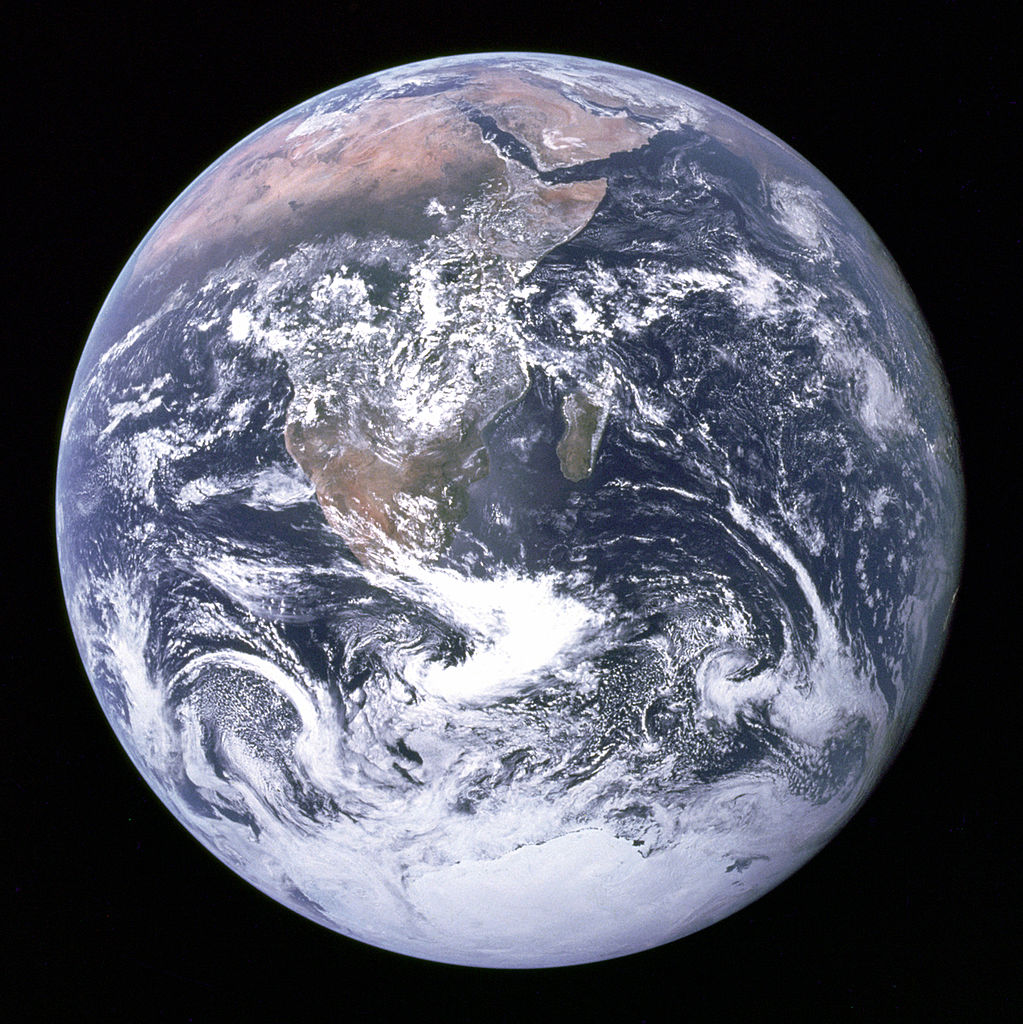
Gilroy wrote:
The last third of the twentieth century saw our world become a different kind of object, approached through a geopiety that operates on an earthly scale and is not oriented by fundamental concern for the sovereign territory of national states. Images of the Earth photographed from outside its orbit by the Apollo spacecraft in 1972 have emerged as the emblem or signature of this novel planetary consciousness.
This now ubiquitous image – officially known as AS17-22727, but frequently called “the blue marble” – seems to capture the feeling of a beautiful planet – not a sublime one, let us note, since the frame limits the infinities of space – that can now be seen as a single whole, and also as desirable, vulnerable, and the object of a certain potential nostalgia, since it can now be photographed by human technology no longer bound to it. It’s important that it is a photograph, not a painting: this assures us that we are admiring the real planet, not an imagined one, and so must face its reality. It is also small; all alone in the frame, without a moon, without a solar system, without a galaxy.
Concurrently with Gilroy, Spivak floated the name “planetarity” as a radical alternative to “globalization.” For her “planet” is opposed to globalization’s use of “globe.” which connotes abstract cartography, the highly abstract sense of a territory mapped for dominance from a commanding height, in Spivak’s words: “In the gridwork of electronic capital we achieve that abstract ball covered in latitudes and longitudes, cut by virtual lines, once the equator and the tropics and so on, now drawn by the requirements of Geographical Information Systems” (72). “Planet,” by contrast, is meant to imply the complex links of the geosphere, biosphere, and sociosphere. It is arguably much less abstract than globe because it assumes complexity and creative chaos, difference and dispersion, along with new consolidations. Spivak’s “planetarity” is extremely vague, intentionally so, since it is meant to evoke a sense of radical alterity as well as the familiarity of a home-world. Spivak’s planet earth, one assumes, cannot ever be captured in a photograph from anywhere, let alone from space. It is primarily the condition of ceaseless flows of people and their cultural practices across scales. It implies also the effects of human practices on the physical planet, and presumably a complex ecological dialectic of feedback between the human and non-human flows.
If this is the sense in which this Symposium and series is using the term planetarity, I understand why the problem is framed as one of imagining it – how does one create useful images of something so metamorphic, indeed chaotic, and yet supposedly recognizable as One Big Thing. From the perspective of science fiction’s artists and audiences, any planet is a set of creative potentials, Earth included. Mars, for instance, the most frequent non-terran planet depicted in the genre, can be said to have its planetarity – whose meaning has changed with time; depending on whether one is using the term as an astronomer, an astrologer, or a cultural historian, Mars’s planetarity may have changed in its geochemical makeup or orbital behavior as a result of new scientific information; its role in the horoscope, depending on shifts in the zodiac; or its place in the history of cultural symbols, as result of research in comparative mythologies. Clearly, the Earth’s planetarity is more complex than Mars’s by an order of magnitude – since it involves what Teilhard de Chardin called a ‘noosphere,’ the domain of sentience produced by its enormous population of living beings. (That said, Mars’s planetarity is nonetheless suffused with its potential as a future abode for human beings, worked out in spectacular detail by Kim Stanley Robinson in his Red/Green/Blue Mars trilogy – which underscores science fiction’s influential role in determining the way we think about planets in our time.) And in this sense, there may be an affinity between planets as fictions and this new critical/theoretical concept. For all its apparent radical posthumanist aura, planetarity in contemporary critical discourse is still human-centered, and infused with ethical imperatives. It is, if you will, a problem of myth-making.
Science fiction can be used to make political and philosophical statements; it is in fact often considered one of the best vehicles for them. But like any art, it expresses important aspects of social consciousness about which its cultures are often unaware. It has become one of the main modes of art for depicting the anxieties and desires of societies transformed rapidly and radically by technoscientific changes. As these changes penetrate every aspect of life – from cosmological theory, to sexual intimacy, all the way to cellular behavior – science fiction makes the changes visible and intelligible; and as it gains more and more currency, its images and tropes feed back into the forces that influence social life. The planet in its planetarity, its being as a planet among others, with diverse and indeterminate histories, not isolated in a photographic frame, is one of those tropes.
The immediate problem is the difficulty of framing such a dynamic, fluid, and indeterminate metamorphic system as ‘the planet.’” Fortunately, science fiction has a tool for just that. Allow me to play a clip of the concluding scene of the original version of The Day the Earth Stood Still, a film I consider something of a sacred text of sf cinema.
In the audience’s real world, the year is 1950. Both of the superpowers that have emerged from the War are producing nuclear bombs. McCarthyism is in its infancy; the testing of the hydrogen bomb is three years away; the alliance of nonaligned nations more than ten. The alien Klaatu has arrived in Washington, D.C. to demand a meeting of all world leaders to deliver his message to the planet. The Eastern and Western blocs will not participate if the meeting is held on the other’s soil. After spending some time incognito, getting to know human beings more closely (a process that does not in fact change his mission one bit), Klaatu decides to bypass the governments; he will speak instead to an assembly of the world’s leading scientists. Klaatu is killed by the US military, but he is resurrected by the robot Gort, via the courageous ministrations of a normal American single mother, played by Patricia Neal.
In this final scene, a number of the most important tropes and icons of science fiction are in play. We have an alien, a robot, a death-ray, a flying saucer, a galactic super-civilization of allied planets, a life-restoring super-technology – and from the right-wing perspective of the time we have a dystopia of cosmic communism and an alien invasion, while from a left-wing perspective a galactic utopia to which we might aspire.
Science fiction has traditionally cultivated two main timespace zones: the future of this world, and the radical diversity of other worlds. These are captured in its two main tropes: futurism and the alien, which converge in the many stories about futuristic spaceflight carrying human beings into an outer space populated by a myriad alien civilizations; or, inversely, futuristic technologies that can create aliens out of humans when these technologies are applied to our world. While these narrative elements are used again and again in countless variations, they are neither archetypal nor fixed. One of the attractions of studying science fiction is the way the genre responds to the subtlest changes in scientific and philosophical thought, and yet reinforces that these changes are contained within a great overarching paradigm of technoscientific modernity.
You may have noted that Klaatu in his message equates the people of the planet with the planet itself. It’s a famous line: “It is no concern of ours how you run your own planet, but if you threaten to extend your violence, this Earth of yours will be reduced to a burned-out cinder” — a phrase that was burned into our teenage memories after dozens of television viewings. Now, it is probably well within Gort’s capabilities to remove human beings from the earth’s rim, and it’s hard to imagine that perturbing the solar system would serve the great federation’s purposes. But Klaatu’s civilization is a severe one. Not for a moment does he doubt that human beings are collectively responsible for their politics, and the politics is planetary. They do not just possess the physical planet, Klaatu’s federation identifies them with it, as if the physical earth and the human sociosphere were fused, and so equally responsible.
The film was remade in 2008, with Keanu Reeves playing the role of Klaatu. In it, the mission is different: now it isn’t nuclear weapons and imperialist intentions, but ecological catastrophe that spurs the aliens to destroy, not the planet – which they are acting to save – but strictly humanity. Here is its conclusion. Klaatu has just been persuaded to save a single child just before the destruction goes total (cheesily represented as clouds of omniphagous locusts). He melds with the sphere, disappears into it, and essentially switches it off.
Contrasting with the original version’s stern, Bauhaus beauty, the later film is a bit of a mess, aesthetically far inferior to the original. But its choices are interesting ones. There are many alien spheres landings throughout the planet, not just in the US, and the space vehicles are spheres intended to act as arks for saving specimens of terrestrial life before the planet is wiped out. These spheres are intriguingly earthlike with constantly changing, strangely swirling interior atmospheres of clouds, gases, and lights, designed via a volumetric particle system based on chaos theory. The technology they represent clearly evokes a very different one from ours – while yet physically emulating the planet itself. The implication is that Keanu Klaatu’s aliens are more allied with the earth-as-biosphere than with the deletable human species.
The two films are different in many ways, and seem to come to opposite conclusions. The 1950 Klaatu really has no authority to change the terms of his ultimatum, and his sympathy for everyday human beings cannot affect the ultimate point. The day that the earth stands still is an actual event, in which Klaatu demonstrates to humanity his technology’s ability to interrupt humanity’s blind habits and force it to reflect. The “Earth” of the title is clearly the human sociosphere, as natural processes continue without rupture. We see traffic stop in major world cities, as well as a range of domestic human activities – these are the things that matter. Klaatu really does want to be taken to the humans’ leaders. He is also a recognizable European male who wears his suits well, admires the Gettysburg address, and easily takes on the role of godfather to a boy whose father was killed in the War. In the later film, Klaatu both more emotionless and more flexible; he can persuaded by human caring to offer humanity a reprieve, which he apparently has the power to grant. I surmise (but I can’t be sure) that the title refers to the moment of human social stillness after Klaatu engineers the departure of the spheres. It is never clear – to me at least — whether the “earth” refers to the human sociosphere or the planetary biosphere. Nor is it clear who the saving agents of the earth will be. But it is clear that Keanu’s Klaatu is humanoid by design, not by default. It is not interplanetary law and order than he has come to defend, but earth’s precious biosphere. His civilization apparently feels the geopiety that we, its current denizens, lack.
Both versions of The Day the Earth Stood Still build on a very long sf tradition of seeing the Earth and its human population via the eyes of extra-terrestrial aliens – beings who are able to perceive Earth’s planetarity with ease, unencumbered by our human embeddedness. The great Russian science fiction writers, the Strugatsky brothers, quote in one of their books a (possibly imaginary) proverb: “No one knows who discovered water, but it probably wasn’t fishes.” This might work for planetarity as well. It may take cormorant or a lungfish to discover water, as in science fiction it often takes an alien or an extraordinarily evolved human to see “the Earth” clearly.
SF has since its earliest forms thrived on this trope of seeing planet earth as if from the outside, and often in a system of other inhabited planets, each of which represents in satirical or lyrical form aspects of human life on earth. There are quite a few ancient and medieval voyages to the moon, but the truly science-fictional explosion of interest in these motifs begins in the long 18th century, when they coincide with two of the main ideological commitments of enlightenment thought: the unity of the planet and the unity of humankind. Both of these commitments are culminations of the geographical and anthropological adventures of the early colonial period. The power of scientific materialism inspires authors to imagine a physically extraterrestrial point of view, and a morally extra-human one, from which the species and geographical differences are seen as totalities, and sublimated to their essence. A man standing on the moon, as in Kepler’s Somnium, can see the planet as a single whole in the void of space; an alien intelligence can see humanity as a species being with all its limitations, as do the gigantic Sirian and Saturnian visitors in Voltaire’s 1752 story “Micromégas”.
Gains in scientific knowledge and technology, which gave European societies the power to collect more and more parts of the world, and more and more populations, under their hegemony, were in effect producing the prospect of the “one world,” a planet governed by the unifying “universal principle” of enlightened progress and modernization. The period of European colonial expansion culminates in a grand claim of “universality” for Western European cultural dominance. The concept of the “universum” – adopted from ecclesiastical hegemony and carrying with it a distinctly non-materialist reference to the centrality of human institutions in the cosmos – was with the post-Copernican enlightenment thinkers clearly reduced in focus to the earth, but an earth expanding from within by its future prospects of intellectual liberation for the entire human species, and unlimited communication and material development.
It’s worth quoting from Kant, the most influential voice of this concept of universalization, a passage from his great manifesto, the “Idea for a Universal History from a Cosmopolitan Point of View”:
However obscure [the] causes [of human actions], history, which is concerned with narrating these appearances, permits us to hope that if we attend to the play of freedom of the human will in the large, we may be able to discern a regular movement in it, and that what seems complex and chaotic in the single individual may be seen from the standpoint of the human race as a whole to be a steady and progressive though slow evolution of its original endowment.
While individual careers may seem chaotic, the “human race as a whole” is evolving steadily according to Nature’s plan. By analogy, the same principle applies to localities, regions and countries as well. The edges will be smoothed, the enormous cultural differences standing in the way of progress will be drawn into modernization’s “steady and progressive though slow evolution.” While with the intensification of the colonialist projects into full-fledged imperialism the species unity of humanity becomes basically a pretext for annexing more and more difference into a culturally and economically, if not quite politically unified planet, we can still acknowledge in these ideas the basis for the modern drive for “universal human rights,” a united nations (which Kant prefigured in his essay), and gradual “uplift” of all people previously excluded from full human species membership – women, non-Europeans, children, the disabled — into a utopian world in which there will be no excluded, othered human beings. (Let’s also note that much of this utopian species consciousness is predicated on what has been called a “war against [other] animals.”)
This drive to utopian universalism met with resistance. In the colonized lands, of course, but also in Europe itself, by the romantic counter-enlightenment, and philosophers like Herder who affirmed strongly that the highest value was in appreciation of cultural differences – and awareness that universality was usually a camouflage for the nationalist exceptionalism of the great powers. In a sense, nevertheless the battle was already lost, since even the romantic nationalist movements essentially stipulated to the power of “progressive evolution.” The formation of nation states was deemed necessary – from Bolivar’s Latin America through revolutionary Europe and eventually to decolonized Asia and Africa – in order to make sure that nations could act as their own autonomous modernizing agents. As in Star Trek, the ideal would be “infinite diversity in infinite combinations,” presided over by a consensual cosmopolitan federation with the powers of empire.
The social historian Benedict Anderson has argued persuasively and influentially about the central role of the realistic novel and newspaper journalism in this whole process. Anderson argues that these forms of public discourse became vehicles of national unification; audiences were collected into a metropolitan, bourgeois perspective while reading the dialects that were to become the official national languages. Novels and newspapers were essentially the vehicles of inter-national modernization, ostensibly on each nation’s own terms, pre-empting its colonial exploitation by the great powers, and resolving its own “internal” tensions by consolidating a national elite.
In my view, science fiction (and its ally, popular science journalism) took on a role in the second, accelerated and hypertechnological phase of European imperialism similar to the one Anderson attributes to the realistic novel and newspapers. SF emerged strong after the catastrophes of World War I by addressing a new elite, not the traditional so-called “organic” ruling castes, nor the bourgeois intelligentsia and merchant-adventurers. It spoke to engineers, scientists, and technicians, many of them immigrants to the hegemonic metropoles, many of them with no great allegiance to traditional systems of education and cultural privilege. “Science,” in the 1920s, became the institution and gnosis that could redeem the miserable failures of national projects. It is striking – especially after the technological barbarism of World War I – how much quasi-religious fervor went into visions of technoscientific salvation in Europe and the U.S. These included dreams of scientific Marxism such a J.D. Bernal’s future humanity, living in material and literal “ecstasy” in the form of modular cyborgs with superior perceptive mechanisms and literal telepathy via direct radio communication, brain to brain; the visions of German national redemption and revenge through rocket science; American fantasies of superweapons and utopian cities; and the Russian engineer-prophet Konstantin Tsiolkovsky’s rocket mysticism, which foresaw humanity’s destiny as expanding into the universe, the principles of Russian Cosmism, which remains a powerful intellectual force in Russia even today.
Throughout the 20th century science fiction has been the main carrier of techno-imperial dreaming, as well as a main vehicle for its critique. Throughout the genre’s career we see narratives of human expansionism, wars between civilizations, encounters with alien cultures, in which sometimes the humans are the more developed, sometimes the aliens. We see stories of ethical resistance to high-technological evil, and enormous ambivalence about the conflict between them. We see galactic federations, hegemonies, United Planets, inter-galactic commercial alliances; we see the soft power of mind-control through new technologies. We see grand utopian visions of violence redeemed by astronomical harmony achieved; we see almost as many slave planets and resistance movements. We see aliens standing in for others: animals, women, children, non-Western peoples, machines. We see cosmopolitan affinity groups. We rarely see nations or democracies.
The main tropes of the genre have entered everyday consciousness throughout the world as people strive to cope with radical and rapid technoscientific transformations of their daily lives. Returning to the matter of planetarity, most of these dominant tropes have elaborated enlightenment modernity’s drives to imagine the earth and the species from a distance and have sometimes inspired major technological innovations or made them imaginable. From this perspective we can argue that science fiction has been one of the main propaganda arms of modern Western humanism, of which imperialism is the main political evolute. Darko Suvin, perhaps the most seminal theorist of science fiction, has argued that the defining effect of the genre is what he terms “cognitive estrangement.” Science fiction presents the audience’s ideology-saturated world at a distance, “estranged”; its fantastic extrapolations from current trends or careful, logical analogies with current conditions make us cognitively aware of the invisible conditions of our real lives, of which we are kept intentionally unaware by the managers of ideology. Through such cognitive estrangement we “discover water,” as it were. This is a classically humanist critical maneuver, liberation of critical intelligence from the illusions of ideology. It is not unlike the moves by Gilroy and Spivak to estrange our globe and make us see it with fresh, critical eyes as our “planet.”
It is not quite so simple as that, however, because it doesn’t end there. While science fiction does indeed rely on the figures of what we currently call humanism – the range of egocentrisms from Eurocentrism, androcentrism, species-centrism, logocentrism, etc. –, it has also been the most non-humanist of popular artistic movements. A quick glance reveals that sf has been posthumanist before the letter.
The Enlightenment project relies on the consistent application of rational critique to everything that appeals to irrational, unfounded sources of authority. In the 17th and 18th centuries the targets were primarily the village, the aristocracy, and the Church, whose legitimacy derived from tradition, blood, and God. Coupled with the achievements of material technoscience that rational critique made possible, critical thought identified more and more domains founded on irrational beliefs. Seeing the planet and the species as wholes became easier and easier with time, as regimes of calculation were instituted in geography and moral philosophy, and equivalences were established everywhere. With the dethronement of agrarian, aristocratic and clerical dominance, the main remaining repository of irrational authority in the West was “Nature.” At that moment, one of the founding moments of modernity, the enlightenment project turned on itself, by virtue of its own rigorous logic. The basis for the earlier critiques had in fact been Nature, which had then been viewed as an autonomous, law-abiding and law-giving force that ruled material reality impartially and without need for sacrifices. Its legitimacy was proven over and over again through the experimental process – which we might view as the ritual Mass of science – and the steady invention of machines that palpably increased material security, comfort, and efficient production. However, the greater the success of these materialist interventions, the less hard and fast the supposed laws of nature appeared. By the 20th century such “natural” categories previously considered self-evident in Europe, as race, gender, and levels of social development could no longer be considered essences or archetypes. In our time we have passed what earlier generations might consider a tipping point, when the inherent de-naturalizing force of rational critique and the technologies it underwrites turn against all the categories that were once considered “natural” – including its own critique. Consider our contemporary views of gender and the technoscientific means to re-construct it. Consider our views of race, ethnicity, nationality, of genetic destiny – now considered, not least by theorists like Gilroy and Spivak, as social-historical constructions, which, while they might once have had some legitimacy have been dissolved on the ground by the planetary interferences and flows. Consider our views about reproduction, once considered the core of the natural in human life, as a process reproducible ex utero and manipulable in utero. Consider the widespread sense that human cognition and self-presence can be artificially simulated or dramatically altered by Artificial Intelligence and Augmented Reality. The very concept of nature is so entangled with the distinct cultures that posit it in widely divergent ways that a number of writers have taken to using the term “naturecultures.” Consider the questioning of the human/animal divide, which Jacques Derrida considered the founding quarantine on which the very idea of the human being was based. We already have one foot in the age of what I have called “artificial immanence,” when everything that previous cultures have thought to be a function of divine or natural power has either been performed by human technoscience or is believed to be available to it in time. Consider also that the basis on which this immensely successful project of critique operates is itself subject to its own critique, through the deconstructive strategies on which so much posthumanist and post-colonial theory is based. If so many aspects of what we have considered essential for our sense of personal and species identity have been dissolved and reshaped – from our birth communities to our sense of continuity in time – why should the planet be left out? Why should the power of critique and technoscientific analysis respect “geopiety?” Reason does not usually respect piety.
Science fiction has been the only form of popular art that has been completely at ease with this malleability of matter and volatility of experience. SF artists long ago imagined that people could be more than one gender in a lifetime, that there might be well functioning homosexual societies, cloning regimes, artificial intelligence of planetary proportions, hyper-intelligent animals, artificial realities, versions of what Paul Simon called “lasers in the jungle.” At the same time, no one would mistake science fiction for a hyper-rational genre – and not only because most of it is written for ephemeral popular entertainment. In the end, science fiction is more interested in diversity than in rationality. Every work of sf is expected by its audience to supply something new, something that differs from all other works. Suvin has argued that the core trope in sf is the “novum,” the new discovery or invention that causes the most important changes in the story’s world. This is true at the level of narrative invention as well, as each work is expected to provide a novelty within the megatext of sf. This probably spurs sf artists far more than any inherent loyalty to scientific materialism. Technoscience is by far the greatest supplier of novelty in our time – and perhaps in any time before us.
Back to the planet. What is a planet deconstructed? The Embedding, the first novel by Ian Watson, one of the most inventive British sf writers, depicts just such an earth. The story has three threads, which intersect in surprising ways – they are indeed mutually embedded. One story is about a mad linguist who tries to raise a group of aphasic children in a laboratory to become monolingual speakers of an artificial language. Another thread is about a remote tribe in the Brazilian Amazon that is known to speak a two-tiered language, one for everyday use and another used exclusively for rituals and myths in a religion centered on a unique hallucinogenic fungus in their village. The third is about the arrival of a fleet of alien beings, the Sp’thra, who have been traveling through the galaxy for 12,000 years. The Sp’thra have been searching for another civilization, which once lived with them and gave them great knowledge, and then vanished into another reality, which they could access through language alone. On their quest, the Sp’thra stop at planets inhabited by intelligent beings, and offer to exchange knowledge of other intelligent beings and the means for interstellar flight for the brains of eight people who are entirely monolingual (in different languages). Since they possess the means to map languages directly onto brains (and to record them from others’), the Sp’thra take these brains to a satellite they call the Language Moon, where they hope to construct a language that will reveal a higher reality to them. In the course of things, we discover that the ritual fungus language actually does have magical, timespace shaping qualities, while the children of the artificial language go mad, and the aliens are destroyed by human missiles.
The action of The Embedding takes place on earth, in a time that seems only slightly ahead of its publication date, 1973. Its many thrilling ideas are derived from theories quite familiar at the time: Chomsky’s Universal Grammar, the Whorf hypothesis, Levi-Strauss’s concept of myth-language, among others. But even where the ideas and plot-elements seem familiar, Watson rigorously constructs a grand network of fissuring alterities. I wish I could elaborate on the riches of the novel, but it would take much more time than I have left. Suffice it to say that The Embedding rigorously uncovers the otherness embedded within a great many of our most cherished modern concepts in anthropology, linguistics, politics, scientific materialism, and science fiction itself. [Jaleel quote;’ more non-Western sf]
How did we arrive at science fiction’s posthumanism after establishing its humanist, enlightenment pedigree? The same way, I warrant that we can trace the posthumanist, post-post colonialist interest in planetarity as a discipline of alterity back to its humanist core. The key actor is the alien. Without an estranged, exterior perspective, the idea of the unity of species and planet is hard to imagine. Without the other, there can be no identity. This is obvious, but bears repeating: identity and alterity are inter-defining concepts; neither concept has any meaning without the other. The Kantian ideal of a unitary cosmopolitan human community requires an alien observer who is not a part of it, but can understand it. Kant believed it was God; Derrida believes it’s the animal. By the same token, the constant affirmation of alterity that we see especially in Spivak’s planetarity requires the differential identity of the human species.
Now, there is yet another dimension, yet another identity/alterity dialectic that I must mention, but can’t possibly do justice to. We have noted the constancy of critical rationality in the development of humanist and posthumanist concepts of the species-planet. Anyone familiar with the language of post-structuralist and posthumanist theory knows that its critique of humanism is that it is insufficiently rational, that it did not examine its own unconscious premises and shadows thoroughly enough. It’s natural then that we should ask: what is the other of this method, who is its alien? In the case of scientific materialism, I think the answer is plain: the attribution of life, spirit and intention to what is apparently non-living or non-sentient. For the posthumanist project as a whole, the enabling alien concept is freedom – just as it was for Marx. For without the underived value of freedom, there is not much point to the project of dispelling illusions. For planetarity specifically, this would mean affirming that planets, and ours among them, have “minds,” and that these are oriented toward greater freedom, either for themselves or for the planetary collective. Gilroy certainly hints at this problematic when he writes of “geopiety.” But there are more than hints available to us. The hermetic tradition in the West, and many other traditions around the world, conceive of planets as having minds. They may be gods, demiurges, or angels. Science fiction artists have often adapted this tradition, especially in the genre knows as “planetary romances.” With some the provenance is so marked we can speak of “séance fiction,” in which interstellar travel is just a variation of astral travel, aliens stand ins for planetary spirits, and descriptions of alien planetary phenomena versions of esoteric knowledge. David Lindsay’s Voyage to Arcturus, Edgar Rice Burroughs’s Princess of Mars, and Olaf Stapledon’s Star Maker, come immediately to mind. The Gaia hypothesis is our most recent and prominent adaptation of this current, but we can see traces of it throughout science fiction.
Are there conclusions to be drawn from this that will help us to imagine planetarity? The only evidence provided by sf – the artform most comfortable with the planetary scale of reference – is probably that everything we imagine is planetarity. We can never escape our inner aliens, and it would be madness to try.
 welcome to MIND MONKEY PROJECTS