
The Solaris Problem: Anomalies in Science and Science Fiction.
Invited lecture, University of Alabama – Huntsville Honors College, September 2015.
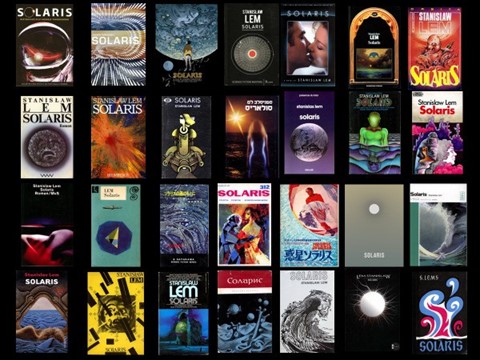
I’m honored to be here today, and excited to talk about a book that has had a profound impact on science fiction studies – the field I have been working in for almost forty years — and on modern literature as a whole; and has also been very important for me personally. I congratulate your Honors Program for choosing Stanislaw Lem’s novel Solaris as a core text. It’s hard to imagine a book that does a better job drawing philosophical, scientific and literary concerns into its unified narrative field.
Solaris appeared in Polish in 1960. It was translated three years later into Russian, and into French in 1966; an English translation from the French version appeared in 1970. It was retranslated into English from the Polish original in 2011. Lem was already a popular and admired writer of sf in Central and Eastern Europe when the book first appeared. With Solaris, he became the unchallenged leading writer of sf in Europe. In the Soviet bloc, year after year Solaris was voted the best sf of all time by readers. This is significant, because Russian and Central European sf has a long pedigree, going back to the mid-19th century, and represents the most important counter-tradition to the British-French-American approach to sf that became the commercially dominant one. Soviet/Russian sf stressed utopian ethics over romantic adventures; its stories were usually about the way technology could lead to the creation of a utopian society for the collective human species, and about the obstacles facing to it – obstacles such as capitalist greed and the resistance of nature. This style of sf struck Western readers used to space opera and dystopian visions as tedious and moralistic. But to young scientists and engineers in the Communist states, it depicted the prospects of a scientifically advanced and just social world – as well as humanity’s destiny to travel to the stars. It’s safe to say that Russian sf inspired the Soviet space program, which in its inaugural years was far more advanced than that of the US.
Lem’s early novels and stories fit into this paradigm, but he was always more ironic and skeptical than his Russian counterparts. As a Pole, he had little sympathy for the Grand Destiny of Man narrative so dear to the Russians. As for US sf, Lem was openly contemptuous, considering most American sf to be cheap and tawdry, a betrayal of the great promise of sf to be the philosophical literature of the scientific age. From this perspective, Lem belongs even more to another European tradition of sf, that of literary fantasy. Since the 18th century, European writers have treated fantastic fiction as a completely legitimate genre, equal in all ways to realism. Fantastic fiction was considered a natural medium for philosophy and satire, and most writers still treat it as one of the genres that a professional writer should master. Even great realists felt the need to write works in non-realist modes to prove their professional bona fides. SF is only one kind of fantasy among many, but as scientific and technological thinking became more and more pervasive, more and more artistically ambitious European writers produced works of literary sf, although very few chose to write it exclusively.
Lem did. His philosophical and scientific erudition, and his brilliant prose – full of neologisms that have the effect of scientific poetry – along with his ability to move from folksy humor to sublime visions of a posthuman future – made him the most translated and admired writer of sf outside the American tradition in the second half of the 20th century.
Yet, even in the body of Lem’s achievements, Solaris stands alone. It is arguably one of the most original, intellectually sophisticated works of sf ever written. Many critics have argued that it shows sf’s full potential to be a philosophical literature, and maybe even a speculative branch of philosophy. In the sentient ocean of the planet Solaris, Lem created an alien being that challenges every reader to reflect on Western conceptions of science and its purposes – and in fact challenging every Western concept of what it means to be human.
I’d like to backtrack here a little, to look at the literary ecology of sf as a specific way of imagining the world. Sf’s characteristic universe – what in criticism we call its megatext – is concerned mainly with two zones of thought: the first is the new – that is, things that have not existed before in history –, and the second is the other – that which is radically different from familiar experience, but is still grounded in material reality. The quintessential figures for these zones are the future and the alien. The future is where things and events will emerge or will be discovered that the past does not know about. The alien is the being that is sufficiently different from what is known that human beings can contrast themselves to it, and sufficiently similar that we can compare ourselves to it.
This may seem like a strange way to define the alien, but I believe it’s an essential reason for our fascination with it. Whether real extraterrestrial intelligent beings exist in our world is not the question; there is more reason to doubt their existence than not, but this seems counterintuitive, given the immense likelihood of there being inhabited planets and advanced civilizations in the universe. Their absence from scientific investigation and most terrestrial humans’ lives is an enigma – the mystery of the silentium universii, the silence of the universe. But even more than a scientific puzzle, it is a philosophical one – indeed, an existential one. Given the characteristic self-centeredness of human minds, which extends from each person’s sense of being distinct from all others to the humanistic proposition that the human species is different from all other living things, this lack of intelligent beings similar to us that are also different means we are radically isolated in our own psychic world. Human beings have historically viewed themselves are distinct from animals, angels, gods, inorganic objects, machines, in fact everything around us. In religious cosmologies, our distinctiveness is not radical. There are hierarchies of beings, many of which are invisible to physical eyes, and human beings are positioned within systems of sentience. In many Native American religions and in Hinduism, there is no drastic difference between animals and humans, for example. In medieval Christianity, human beings occupied a specific rung on a Great Chain of Being – and given the importance of human salvation for the world view, angels and fallen angels were very interested in our lives. Among the ancient Greeks, the gods meddled with humans, took the shapes of animals or weather, and in the Homeric poems even descended to earth to fight battles among them. In many schools of Buddhism, every being in the world is endowed with a shared awareness, even what we consider inanimate objects can hope for enlightenment. When empirical material science becomes the dominant world view, these enchanted systems evaporate. Instead of chains of being and mythic relations, we view the world in terms of physical cause and effect. These cause-and-effect chains become quite complex, but one thing they cannot be, by definition, is intentional. Material science resists anthropomorphism, refusing to use human mental models as metaphors for natural phenomena. The notion of objectivity emerges – the demand that we imagine things and events as if without a perceiving subject. Material science also resists the idea that these objective processes have purposes, other than perhaps their own existence, although even that begs the question why something should desire to exist. Desire is a very intentional and mental quality. Evolution has no particular goal, even if we believe that certain tendencies exist, such as the notion that organisms tend toward complexity and internal specialization. In this perspective, human consciousness is a materially emergent property that is unlike any other in the material world. In a sense, it is a singularity – that is, a phenomenon that is so distinct from its environment that it is enclosed within itself. We are so special in the scheme of things – at least in our own eyes – that we have nothing to compare ourselves to. And consequently, in an important sense we do not know what we are. In the novel Snaut (renamed Snow in the printed translation), the melancholic and skeptical Solarist cybernetician who stands in for Lem himself, believes we like it that way. He tells the protagonist Kelvin: we do not really want to know others. We want to see ourselves in larger and larger mirrors, to admire our power to make the universe in our own image. We say we are looking for contact with others, says Snaut, but “we are only seeking Man.” And if we only have “Man,” we don’t know that is. Underneath, Snaut (and Lem) have the nagging suspicion that human beings are longing to find something that is not “Man,” a mind that can’t be shaped into our own image, something can’t be brought under control even by the proud power of human intelligence. Something that is similar enough to be recognized as a complex sentient being, but different enough to show us in the light of an other. In a word, a true alien.
Snaut says we are looking for mirrors. Most of sf’s aliens are – let’s be candid about it – mirrors. They are too much like us to be useful for contrast. I’ll give more attention to this in my other talk this week. For now, let me just say that most of our aliens are based on things that are only slightly different from the bourgeois Western subjects that are the main audience of sf. When we examine them closely, we see they are usually based on beings bourgeois Western subjects are quite familiar with – nonhuman animals, human-constructed machines, non-Western people, children. In general, they are not persuasive others, they have been othered. Our relations with the aliens of sf is usually a displacement of anxieties of domination – aliens either are occasions of tolerance and forgiveness, or they represent beings we have repressed who are coming for revenge. Most aliens communicate with us fairly easily, and if there are obstacles, they are easily overcome. They often speak good English, perhaps through a universal translator; they use some cosmic version of C++ or the pentatonic scale. They also care about us – either because they want our blood and green earth, or they need our co-operation. They have intentions in which we figure. And we ultimately figure all this out for ourselves. They are pretty damn human.
Into this context swims the planetary mind of Solaris. It does not communicate with humans – it may not consciously communicate at all, with anything. It controls a stable orbit around a binary star that allows it to be homeostatic – something unheard of in our universe. It creates sublimely monumental, but ephemeral structures. Human scientists do not how it’s done, and they don’t know what they are—are they sculptures, cities, materialized concepts, organic physiological processes? And if in the end contact is established, the Solarists can’t know what the planet is doing with it, what it wants, and indeed whether it even has what we call intentions.

Solaris is as close to a truly alien being as sf gets. It is so opaque to the Solarists that it too become a mirror, but a different kind than the one Snaut has in mind. Because the maybe sentient, maybe living ocean is impenetrable, all that the Solarists can discover through their experiments is what it is not: it is not any of the things that human minds have captured and controlled through our science. In a word, it is not us. Instead of reflecting human power in the universe, it shows us human limits.
The eminent Israeli sf-theorist Elana Gomel believes this makes Solaris an exemplary piece of posthumanist fiction. There are many currents of thought called posthumanist at the moment – there’s the radical ecological vision of the earth liberated from human domination; a hypertechnological vision of human beings merging with machines to overcome our species’ biological limits; a vision in which human beings are not superior to, but interdependent with other animals; a Buddhist-inflected image of universal interdependence liberated from human egoism. One thing that all these currents have in common is their antagonism to the concept of humanism: which they define as the view that human consciousness and civilization are the highest, most important properties of the world, the source of all value. For posthumanists, all our ideologies of exceptionalism and domination can be traced back to this basic egoism: not just anthropocentrism and egocentrism, but ethnocentrism, patriarchy, racism, speciesism, and scientism. It’s easy to see why Solaris would fit into this world view – the planet is an embodied refutation of the idea that the human mind can understand and dominate everything. In one of the books Kelvin finds in the space station’s library, one eccentric Solarist proposes that even the most abstract scientific cosmological theories reveal that they are patterned on the human body. I would agree with Gomel that these ideas are at the core of Solaris, but I disagree with the use of current terms like posthumanism or anti-humanism for it. In my view, Lem is drawing on a tradition of skepticism about human limits that goes back at least to the 16th century French thinker Montaigne – a view that holds that we are necessarily limited by the conditions of our human consciousness. No matter how much we learn, we will never escape those conditions and they color everything we perceive and know. For many historians this skepticism is as much a part of humanism as its antagonist, anthropocentrism. I think an 18th century reader during the European Enlightenment would have understood Solaris quite well. We don’t appreciate the originality of Solaris if we try to make it serve an ideological purpose.
The planet Solaris is in fact a double-other: it is not only a convincing alien being, it is an anomalous one. Since it is a figment of sf, the book itself and its story are anomalies, too. The model for the planet Solaris is not some familiar category that is exaggerated into strangeness. Its model is anomaly itself – a phenomenon that will not fit into the order of things. It forces us to think about the concept of the anomaly, both in science and in sf. Lem’s whole body of work displays his fascination with anomalies. In scientific thinking, anomalies are historical drivers of discovery and invention. The history of science can be told as the perpetual encounter with anomalous phenomena that won’t fit into the dominant paradigms of scientific rationality. They are the sand from which pearls of wisdom emerge. Often when we encounter an anomaly, we bracket it, put it to the side, and get on with our business; it may only be a glitch, caused by faulty hardware, poor calculation, or incomplete understanding of the implications of a theory. But sometimes, when it turns out to be something that can’t be renormalized, it has to be faced – acknowledging the risk that it may force us to change our whole understanding of the universe. During the Turkish invasions of my ancestors’ homeland, Hungary, in the 16th century, the Turks would not attempt to take every fortress on their route. Sometimes they would pass one by, leaving it intact, knowing they could come back later for it because it was weak and isolated. But some castles had to be taken whatever the cost, because they were potential sources of resistance that could weaken the occupying army. Grand anomalies are like those fortresses. Scientific inquiry can’t just pass them by – if they do, they may fatally weaken a theory or a research program, and even, in the popular imagination, scientific rationality itself. Many of the most important advances in science are the result of grappling with such anomalies. The planetary orbits, bacteria, the platypus, viruses, x-rays, and pulsars are just a few examples of problems that challenged the existing structures of scientific explanation so much that they forced those structures to change to accommodate them. We still have them and will continue to as long as new knowledge keeps uncovering what one theorist has called “new abysses of the unknown.”
Solaris is one of those fortresses that can’t be ignored, yet can’t be taken. For Lem, anomalies are interesting not because they inspire heroic scientific romances of overcoming Nature’s resistance. For him they represent the inevitable limits of human rationality. Some anomalies cannot be encompassed. From Lem’s perspective, anomalies are challenges to human hubris, the very modern pride that human beings can understand the universe of human terms, in human structures. Even though the modern scientific temper discards myth and magic, it is enamored of its power to convert knowledge about Nature into greater and greater conceptual empires – of which empirical science is the greatest. So we can read the novel Solaris as an extremely sophisticated satire on the evolution of Western science. We see it in the history of the steps taken by the Solarists to understand the planet. Again and again they try to combine and apply familiar knowledge – the planet may be a “homeostatic mechanism,” a strange magnetic geological formation, or a single plasmic cell. Once they are convinced that the ocean is alive in some sense, and sentient, the models of the past go out the window and the explanations become more and more fantastic. The non-communicating mind that controls its orbit must be an “autistic ocean” or an “ocean-yogi.” Its resistance to human understanding even takes on erotic coloring – it is rejecting our advances, and elicits the characteristic resentment of spurned male suitors who aren’t used to not being the most dominant Alpha in the room. The adventure to understand Solaris seems to fail – the anomaly of a non-communicating, sentient single-celled ocean capable of constructing human simulacra out of massless neutrinos is so great that the failure threatens to take science itself with it. The center of science will become a planet-sized void of human beings’ inescapable ignorance. More and more fantastic and anomalous hypotheses are generated to explain the unexplainable – summed up in one Solarists’s determination that the planet belongs to a class of beings named “metamorphs,” a class consisting of only being, the ocean-planet itself.
While the novel takes this theme of scientific anomaly to a near-mythic scale, we shouldn’t ignore that the novel Solaris is a work of art, shaped within the fields of sf and literature. And from this perspective, the novel itself is an anomaly, as was Lem as a writer. Lem folds scientific and cultural anomalies into each other. Some forty years ago, at the very beginning of my career writing about sf, I wrote an article about Solaris I entitled “The Book is the Alien: Certain and Uncertain Readings of Solaris.” I was interested especially in the way Lem makes the readers of his book imitate the Solarists exploring the ocean-planet. Both are caught in an interpretive bind – they have to use the models they have available to them, the strategies they have learned to make sense of things in the past, but they can’t be certain that their interpretations have any validity. Reading the descriptions of the mimoids, symmetriads, and asymmetriads, for instance, readers try their best to boot up some familiar analogies to decode the design. The Solarists offer a few of their own – they are like the embodiments of transcendental equations, for example – but they know these analogies are probably useless, they only help fill in the void of ignorance. (And Lem is having his own joke, since very few of us are familiar enough with transcendental equations to be able imagine them as elements in a metaphor.) The novel isn’t a natural phenomenon, of course; Lem constructed it himself. However, he always maintained that he had no idea what he was doing as he was writing it – and so, if he is to be believed, it is the product of his unconscious, as opaque and inaccessible a zone as Solaris itself. Lem’s critical writing hints at some possible models for making sense of the book as a novel: he singles out the fiction of the French avant-garde novelists in the 1960s and the enigmatic works of Franz Kafka. But these don’t help, either, since those authors wrote fiction that inherently resists interpretation.
Sf as a genre also privileges anomalies. One of the core narrative elements that distinguishes sf from other genres is the appearance of some new, unpredicted phenomenon that changes the course of history and social life. Sometimes it is discovered, sometimes it is invented – an asteroid headed straight for the earth, a death ray, an alien visitation, an artificial intelligence with emergent self-awareness, a human-machine fusion. In sf studies, these are called novums – from the Latin word for new things. In sf, these novums are at least ostensibly material phenomena – in other words, they can’t be miraculous or divine interventions. The science-fictional novum fuses the two sf zones of the future and the alien: its appearance marks the beginning of a future different from the past in which it did not exist, and it forces the familiar understanding of the world to change. It is a dramatic anomaly. It is a dynamic, dramatic anomaly that forces the world to change. Nothing that sf has produced surpasses the ocean-planet as a novum – neither in the Western or the East European tradition.
In the 1950s, Soviet astrophysicists began to explore ideas about extraterrestrial civilizations. Their debates culminated in the early 1960s (and so immediately after the publication of Solaris) in models that tried to imagine the parameters of alien civilizations, the social and technological evolutionary laws that govern civilizations on a planetary scale. They were trying to imagine the possibilities of contact, but also to come up with paradigms for viewing human civilization’s possible evolutionary paths in the nuclear age.
Lem used some of these models in his other works, but in Solaris he did something radically different. He proposed the idea of a non-social, non-civilizational form of highly evolved alien intelligence, and he depicted it with ruthless imagination. This may not seem like a big deal at first – sf has produced more than one powerful non-social alien. For example, there is the great intelligent gas cloud in The Black Cloud, published in 1957 by the eminent British astronomer Fred Hoyle, a book that Lem admired. But it, too, it turns out, is on its way to meet up with others of its kind in another galaxy.
Here we need to return for a moment to the conventional image of the extraterrestrial alien. While xenobiologists may expect to discover forms of life that are exceedingly strange compared to ours, perhaps even based on different core elements, most of our stories about “the alien” hinge on communication and contact with us. In that sense, they are allegories for our concerns about contact among divergent human cultures. Going back to the notion that aliens are for contemporary human beings imaginary supplements filling in the void of our isolation in the universe, we expect aliens to have some commonality with human intelligence, and specifically with social and technological intelligence. We also expect them to have some of our core traits in the material world: we expect them to be mortal (or if they are immortal, it is because they have discovered material means to prevent death); and we expect them to have needs, which entails a sense of their own limits.
In the Soviet sphere, this was not only a tendency, it was for many years a doctrine. Based on Friedrich Engels’s writings on the evolution of human societies, it was believed that intelligent extraterrestrials had to be humanoid. To depict them differently was a violation of a Marxist-Leninist tenet about universal evolution. Many times in his career Lem challenged this dogma by depicting aliens that were non- humanoid – and yet he imagined that they would have advanced technologies, even if they did not have the ability or desire to communicate with human beings. It is with Solaris that the challenge is most uncompromising. The planet is an enigma that no rational human models can encompass. It can’t be determined whether its extraordinary behaviors are natural or artificial, biological processes or intentional creations. If you can’t determine that, empirical science has nowhere to go.
So, with all that originality and intellectual daring in depicting a truly anomalous sentience, what are we to do with this?
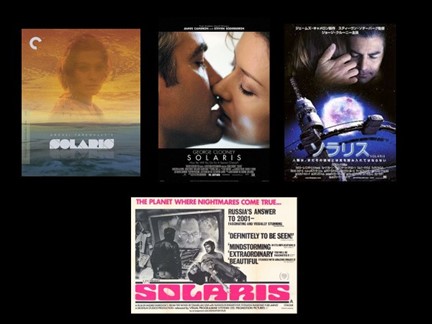
Most people familiar with Solaris probably know it from two film adaptations by celebrated directors, the Russian Andrei Tarkovsky and the American Steven Soderbergh. Tarkovsky’s version is considered one of the great achievements of postwar Russian cinema, and Soderbergh’s … well, it stars George Clooney. As the posters show, both films emphasize the love story between the protagonist Kris Kelvin and the simulacrum of his dead partner, Harey (or Rheya, as the French and English versions have it, as well as Soderbergh’s film). In neither film do any of the cognitive challenges posed by the alien ocean play a role. Both films ignore the marvelous opportunities of depicting the ocean’s strange phenomena; for both, the only interesting dimension is the romance. Lem disliked both films. He particularly detested Tarkovsky’s; he felt the great Russian director had hijacked his story, and essentially reversed its polarity. Instead of a story about humanity’s inherent limitations, Tarkovsky filled it with nostalgia for Mother Russia and family mysticism. Soderbergh’s version – which draws from Tarkovsky’s film at least as much as from Lem’s novel – was even more about personal romance. No one who has only seen the films would imagine that the novel is concerned mainly with science. And yet, there is no getting around how powerful and suggestive that love story is. It draws on romantic literary traditions – it’s a ghost story, a story of haunted love. And it hinges on an image of the female lover that is, if anything, not anomalous and not alien. Lem doesn’t include many women in his imagination – there are only a few female characters in his entire body of work. And there’s no way around it: Harey/Rheya behaves like a typical heroine of a 19th century romance – her only free act is to annihilate herself in order to free her hero-lover from his attachment to her, an attachment that prevents him from doing his job and continuing on his adventure. And because of the love story, we are left with the feeling that significant contact was actually established between the ocean and Kelvin. The encephalographic messages got through, and the ocean at least understood that it should stop sending the simulacra that were tormenting the Solarists. So, does romantic love conquer the alien, too? Can we know for sure what this love story signifies? Or is it the proof that even Lem, the great dry skeptic, can’t leave the void alone without filling it with familiar human models?
 welcome to MIND MONKEY PROJECTS