
(Unpublished paper presented at the Conference on Global Science Fiction, Wellesley College, March, 2013).
This Fractal, Alien World: SF in the Global Moment
Globalization and sf is a marriage made in heaven – which is not necessarily a good thing, if you have your doubts about heaven. Sf, perhaps uniquely among artistic movements, has had no difficulty adjusting to the currents of globalization. In a sense, it has occupied that ground before history and political economy arrived there.
1. Here is a somewhat disorienting fact: observation of the planet earth from the outside is a very recent phenomenon – I mean not only actual observations, but imaginary ones as well. In fact, sf has a good claim for being the first mode of thought to imagine seeing the earth in this way. Pre-modern astronomers and visionaries often imagined astral traveling to other planets and the forms of life that might be on them; the earliest, pre-Enlightenment heroes of sf often traveled to the Moon and beyond — but they rarely looked back. The earliest versions of this extraterrestrialist perspective on the earth were probably Fontenelle’s Entretiens sur la pluralité des mondes in 1686, and especially Voltaire’s Micromégas in 1752, which introduced two of sf’s core motifs: extraterrestrial visitors with superior capacities and the satirical estrangement effect of seeing human folly as a planetary affliction. In the technoscientific age, sf’s pride of place in representing this extra-terrestrialist perspective on the planet is even stronger. Here are two of the first passages describing the earth seen as an object of a scientific, materialist extraterrestrial gaze. The first is from Jules Verne’s Around the Moon, published in 1870. The team of lunar explorers – who, by the way, never touch down on the moon’s surface – observe the curve of the earth through a porthole, as it wanes toward the new. They see only a thin crescent of light,
and the tops of high mountain peaks periodically obscured by clouds. Most of the planet is obscured in night. After a round of detailed astronomical explanations, the narrator closes with a cosmic view:
This was all they saw of the globe lost in the darkness, an inferior star of the solar world, which for the grand planets rises or sets as a simple morning or evening star!
Imperceptible point in space, it was now only a fugitive crescent, this globe where they had left all their affections.
The other passage is much shorter, but has had a greater effect. They are the opening lines of H.G. Wells’s The War of Worlds, published in 1898.
No one would have believed in the last years of the nineteenth century that this world was being watched keenly and closely by intelligences greater than man’s and yet as mortal as his own; that as men busied themselves about their various concerns they were scrutinised and studied, perhaps almost as narrowly as a man with a microscope might scrutinise the transient creatures that swarm and multiply in a drop of water.
Such off-world gazes don’t abound in either author’s work – but they are potent. Verne’s expresses what we might call the solid view: cartographic, physicalist, replete with positive facts, by human beings who have achieved escape velocity into cosmic space. In Verne’s major works yet to come, it will become the cartographic globe that European powers are in the process of consolidating under their imperial science. Verne’s fiction in general delights in the careful, pedantic mapping of the various levels of this globe, which his protagonists master by exploring, describing, and explaining. Wells’s single sentence, by contrast, introduces what we might call the vortical, looping, reflective perspective on the planet, not as an object of humanity’s transcendent scientific gaze, but of another intelligence’s – an intelligence mortal and scientific like our own, in fact so similar that the narrator compares them to the European settlers who wiped out the Tasmasnian aborigines, but on a greater scale: all of terrestrial humanity is inseparable from the whole planet in these alien outsiders’ eyes. It – and we – are small, vulnerable, exploitable, and as it also turns out, volatile and unpredictable.
That references to seeing the earth as a single material object or system are so rare is surprising, since it is one of the tenets of European Enlightenment thought. Gains in scientific knowledge and technology that gave European societies the power to collect parts of the world and populations under their hegemony were in effect producing the prospect of the “one world,” a planet governed by the unifying “universal principle” of enlightened progress and modernization. The period of European colonial expansion culminates in a grand claim of “universality” for Western European cultural dominance. The concept of the “universum” – adopted from ecclesiastical hegemony and carrying with it a distinctly non-materialist reference to the centrality of human institutions in the cosmos – was with the post-Copernican enlightenment thinkers reduced in focus to the earth; but it is an earth expanding from within by its future prospects of intellectual liberation for the entire human species, and unlimited communication and material development.
The first photograph of the whole earth was not taken until 1967.
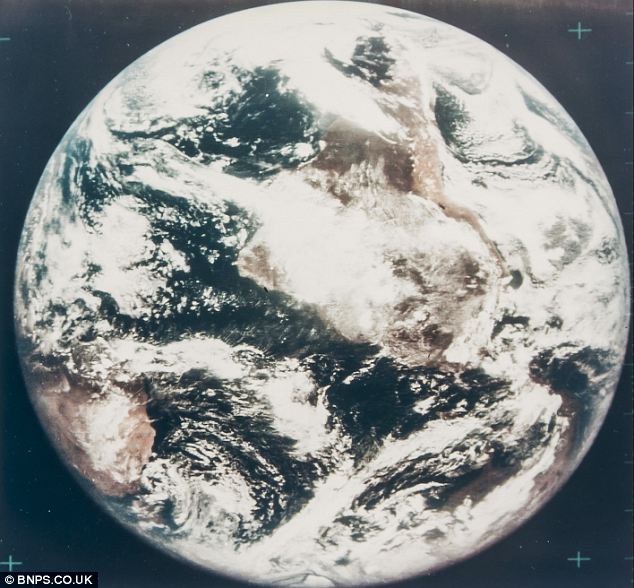
– eventually to be replaced by the more famous photo taken from Apollo 17 in 1972, known as AS17- 22727, or more frequently as the Blue Marble.
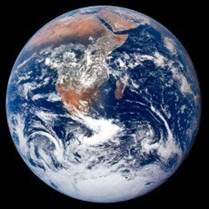
This image had an almost immediate psychological effect throughout the world, becoming the poster icon for transnational ecological and care movements of all kinds. This, too, was foreseen not by the laity, but by Fred Hoyle, a celebrated astronomer and sf writer – writing in 1948:
Once a photograph of the Earth, taken from outside, is available, we shall, in an emotional sense, acquire an additional dimension… Once let the sheer isolation of the Earth become plain to every man, whatever his nationality or creed, and a new idea as powerful as any in history will be let loose.
The image has been adopted by postcolonialist and cosmopolitanist thinkers as the icon of a planetary way of thinking that transcends the technoscientific imperialism of the cartographic globe and contemporary avatar, the gridworks of Geographical Information Systems.
One could dwell a long while on this image – how it captures the feeling of a beautiful planet (not a sublime one, let us note, since the cropping limits the infinities of space) that can now be seen to be desirable, vulnerable, and the object of a certain potential nostalgia, since it can now be photographed by human technology no longer bound to it. As Hoyle understood, it is important that it is a photograph, not a painting: this assures us that we are admiring the real planet, not an imagined one, and so must face its reality. It is small, all alone in the frame, without a moon, without a solar system, without a galaxy. It is, by implication, us. Its implicit message is that earth is coherent, unitary, and lovely, and most of all that the divisions of our social world are unnatural and transient – imaginary, even delusional. Entirely implicit and indeed unconscious is the position of the gazer. Nothing marks the standpoint – even when we know it is an astronaut’s camera eye, the framing, the moonlessness, the intimate proximity create the sense of rapt, indeed trapped, wonder, somewhere between that of 2001‘s Star Child and that of a marooned cosmonaut. I would argue that this icon complements the effect of the Sputnik in 1957; together they create what I would call the perspective of “middle extraterrestriality” as a real material experience, the construction of a real space suspended between the void on the one hand, and home, on the other.
Another, more recent shot from space is one of the many “the earth at night” series, showing the concentrations of energy use visible in the night hemispheres.
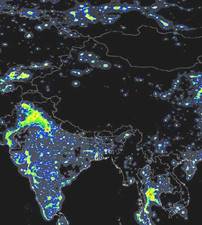
Taken from the International Space Station, this is a more consciously political image. It is more precise and factual than grid or even relief images, because it shows human energies – the transformation of the natural one world to the globe of unevenly distributed power in the Anthropocene. Compared with the Blue Marble’s solid perspective, it approaches the vortical perspective of Wells’s Martians – but in this case the Martians are us, gazing at our resources and their exploitation. Here the one world is not an alien world, a single divine Gaian cell, with transcendent integrity; it is a complex, striated, dynamic network of power-nodes – almost fractal in the structural similarities across scales – all made possible by the luxuriance of the technosphere. Indeed, these are the images of the world as a global technosphere – the position of “near extraterrestriality,” the Space Station’s eye-view.
I would argue that sf is the mode of thought that is most comfortable thinking in terms of such extraterrestriality. “Far extraterrestrialism” is in any case entirely sf’s domain, the terrain of space opera since the days of Tsiolkovsky and Flash Gordon – but both the middle view of the Blue Marble and the near view of the Space Station were prepared by sf long before the actual material images were produced.
The social historian Benedict Anderson has argued persuasively and influentially that the realistic novel and newspaper journalism had a central role in the creation of modern national consciousness. These forms of public discourse became vehicles of national unification; audiences were collected and oriented toward a metropolitan, bourgeois perspective while reading the dialects that were to become the official national languages. Novels and newspapers were essentially the vehicles of inter-national modernization, ostensibly on each nation’s own terms, pre-empting its colonial exploitation by the great powers, and resolving its own internal tensions by consolidating a national elite.
In my view, science fiction (and its ally, popular science journalism) took on a similar role in the second, accelerated and hypertechnological phase of European imperialism. SF emerged strong after the catastrophes of World War I by addressing a new elite, not the traditional so-called “organic” ruling castes, nor the bourgeois intelligentsia and merchant-adventurers. It spoke to engineers, scientists, and technicians, many of them immigrants to the hegemonic metropoles, many of them with no great allegiance to traditional systems of education and cultural privilege. “Science,” in the 1920s, became the institution and gnosis that could redeem the miserable failures of national projects. It is striking – especially after the technological barbarism of World War I – how much quasi-religious fervor went into visions of technoscientific salvation in Europe and the U.S. These included dreams of scientific Marxism such a J.D. Bernal’s future humanity, living in material and literal “ecstasy” in the form of modular cyborgs with superior perceptive mechanisms and literal telepathy via direct radio communication, brain to brain; the visions of German national redemption and revenge through rocket science; American fantasies of superweapons and utopian cities; and the Russian engineer-prophet Konstantin Tsiolkovsky’s rocket mysticism, which foresaw humanity’s destiny as expanding into the universe, the Russian Cosmism that remains a powerful intellectual force in Russia even today.
Throughout the 20th century science fiction has been the main carrier of techno-imperial dreaming, as well as a main vehicle for its critique. Throughout the genre’s career we see narratives of human expansionism, wars between civilizations, encounters with alien cultures, in which sometimes the humans are the more developed, sometimes the aliens. We see stories of ethical resistance to high- technological evil, and enormous ambivalence about the conflict between historical formations. We see galactic federations, hegemonies, United Planets, inter-galactic commercial alliances; we see the soft power of mind-control through new technologies. We see grand utopian visions of violence redeemed by astronomical harmony achieved; we see almost as many slave planets and resistance movements. We see aliens standing in for others: animals, women, children, non-Western peoples, machines. We see cosmopolitan affinity groups. We rarely see nations or democracies. In other words, we see displacements of globalization, avant la lettre.
Sf is still ahead of the game. We are seeing increasing interest in sf by formerly colonized cultures, and by those that were never assimilated to imperial domination – but it is clear that this interest is not entirely innocent. In recent years, sf has become associated with the qualities most desired by post-industrial, post-modern societies. While some may think that this marks the ascendancy of the Geeks and the Nerds, it marks more significantly the ascendancy of technoscientific elites throughout the world. We have heard news that the Chinese cultural commissars, having researched what innovative engineers and scientists in the USA have in common, and found a love of sf to be a strong factor, are beginning to encourage the development of a national sf. We can see the emergence of highly educated young scientific intelligentsia in all the developing non-Euro-American cultures, developments guaranteed to produce the production of sf. More and more sf is being written, filmed, and composed in languages and cultures that only a few years ago were considered in the Third World and terminal victims of uneven development. Sf is taken seriously by artistically ambitious creatives who care mainly about the imagination, working on their laptops with inexpensive CGI gravity engines, as well as by national entertainment industries in India, Brazil, Turkey, and Mexico. I believe these developments are quite natural extensions of the process of cultural modernization so central to the ideas of thinkers like Benedict Anderson. Just as the transnational mode of critical realism became the paradoxical vehicle for national cultural consolidation – so the transnational mode of sf has become a vehicle for the affirmation of national technoscientific modernity. A culture of sf is required for any group to be acceptable to the global elite – an elite that increasingly has more in common with others of its class who have been made by technoscientific advances than with the members of their erstwhile cultural and linguistic communities.
Much of the critical literature on global sf is attached to postcolonialist frameworks. I have been thinking a lot about these avowedly interventionist interpretive positions. I’m not sure whether I will stay with this view, but right now it appears to me that we are observing an extension of the sentimental attachment to group identities that inspired the nationalist cultural revivals of the 19th and early 20th centuries – “revivals” in name only, because they were based on imaginary constructions of consolidations of ethnic and class diversity under the discipline of the nation state. The challenge for nationalist movements – and here I include the enormously successful nationalisms of the French, the British, the Russians, and the Americans, the cultures who were most able to conjure their national interests into supposedly universal human interests applied by their imperialist projects – was to formulate distinctive cultural identity in a way that facilitated adoption of the modernization that clearly originated from the dominant imperial powers of Western Europe. This was the core inspiration for national realism. In a similar way, pre-technoscientific societies are driven to emulate the high-tech transformations of the once and future colonial hegemons. As with modernization projects even in laggard parts of Europe, we can expect forms of “reactionary modernism” – the term Jeffrey Herf applied to Weimar and Nazi Germany’s attempt to introduce technological and economic modernization under the aegis of artificially archaic national mythologies. Contemporary India is probably the leading example of this, but I expect to see it all over the world – including the US, where reactionary cultural forces are nonetheless completely attached to hypercapitalist technological innovation. (It should go without saying, but I’ll say it anyway, there is nothing inherently progressive about sf. It will serve whatever ideology the technological elite chooses.)
This increasing paradoxical interest in sf in places far from the old imperial metropoles is leading to mixtures of ontologies that are supposed to represent the resistant, the unique, the group proprietary. Artists are working on splicing non- or pre-technocentric views to the technoscientific dominant of sf into new global styles, carnivalesque in their mashups of putatively equally valid world-views drawn from different cultural traditions. I would argue that we are seeing something quite familiar. Much of what we consider resistant sf – critical dystopias, feminist sf, race-critical and anti-imperialist sf , etc. – replay the modernist dialectic of urban and rural life, industry and nature, city and country, now expanded to a global scale. But now it is ironized in a way inconceivable to earlier modernist artists because of the disorienting inherent paradoxes of contemporary globalization.
These paradoxes are painfully familiar (if they are not, they should be). In Slavoj Zizek’s formulation, they are dialectical frictions that simply cannot be resolved under current conditions of cognition; they are embedded parallaxes of our hypercapitalist, neoliberal globalized world. Here are some of the ones I think are most relevant for sf:
1. The paradox of the familiar alien, or as many sf scholars know it, the Solaris problem, after Stanislaw Lem’s novel – we are incapable of understanding the truly alien without projecting our models on it, and thus de-alienating it, so that human aliens are measured by their proximity or distance from the embedded paradigms of the norm.
2. The practical paradox of global sovereignty: in the neoliberal regime, the enabling conditions of both state and popular sovereignty are being eroded by multinational corporate interests. Through free-trade pacts, enterprise zones, and maquilladores, transnational economic agreements acquire the power to supersede local/national laws – and these state-subverting agreements are facilitated by the nation states themselves. (A situation brilliantly depicted in Alex Rivera’s Sleep Dealer.)
3. The paradox of situated cosmopolitanism – the view that national and local tribal cultures must be transcended through a new universalism that protects general rights of the vulnerable –, a view that is argued for by people primarily who live in the global cities. These global cities are also known as global nodes in a global network of light-speed financial transactions and the industries that facilitate them – which draw multitudes from formerly agrarian land, depopulating them, parching them, and desiccating the sources of traditional national culture so often used to legitimate the nation-state’s sovereignty.
4. There is the paradox of ontological diversity – the belief that each culture’s traditional or adaptive idiosyncracies have the power to resist the neoliberal, technoscientific leveling, a position that can only be articulated through the technoscientific media.
5. The paradox of normalized queering – that creative resistance to the norm increases cultural diversity, while the hypercapitalist mechanism of commodifying difference in order to create a multitude of market niches creates a norm of the non-normal.
6. And the paradox that I find most intriguing: that of Anglophonic anti-imperialism. English has become the language of international institutions, of “communications skills,” of new technologies. It is the language of the Internet and of international law. In the globalizing regime English is not seen as something that grounds a collective, but an invaluable commodity; one needs it to get a good job. It is the medium of transnational capital. A problem that I feel scholars of global sf must face directly, and unsentimentally, is that of the politics of translation, and the continuing dominance of languages like English in the post-colonial era – indeed, the expansion of its dominance now to include zones that were never under Anglo, or indeed any Western, colonial domination. There has been manifest interest recently in discovering and disseminating national sf’s from cultures that were eclipsed and ignored by the dominant ones. But even these recoveries of Russian, Chinese, Mexican, and other sfs has been entangled in the global informational matrix dominated by US and Anglophonic media. We know of many artists who are considered masters of the mode in non-English languages, but how they can become known and influential on a global cultural scene is very much in question. Moreover, as we try to fight the battles against the old Imperial Machine by encouraging the work of supposedly counter-hegemonic writers of what used to be called the periphery, we must ask unsentimentally: whose voice is speaking? Does it make sense to speak of national or ethnic voices on a global stage, given how completely they must be autotuned to the dominant languages and mechanisms of dissemination? And given the diffusion of cultures through diasporas, migrations, what the Hong Kong Chinese call astronautics, is global sf a process of deterritorialization and deracination that will make differences merely decorative variations on a theme of technoscientific empire? Is the globe of technoscientific globalization made by the International Space Station orbiting a world being made into its own image through the mediations of global sf, film, and the post-cinematic internet?
 welcome to MIND MONKEY PROJECTS